Rental Inventory Management: 7 Ways to Improve Accuracy and Utilization
Rental inventory is the heart of your business. Every asset sitting idle represents an investment that isn’t generating revenue, while every item promised to two customers at the same time creates an entirely different problem.
Effective rental inventory management requires more than knowing how many items you own. You need to know where your inventory is, when it will be available, what condition it’s in, and how effectively it’s generating revenue.
Whether you rent heavy equipment, tools, event inventory, or specialty items, these seven strategies can help improve inventory accuracy, utilization, and profitability.
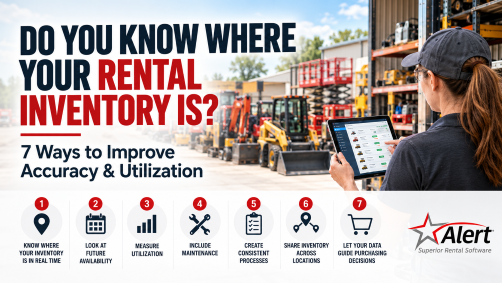
1. Know Where Your Rental Inventory Is in Real Time
“How many do we own?” and “How many can I rent next Tuesday?” are two very different questions.
Your team needs visibility into inventory that is:
- Available
- Currently on rent
- Reserved for future rentals
- In transit
- At another location
- Out for maintenance or repair
- Otherwise unavailable
When employees have to make phone calls, check spreadsheets, or walk through the warehouse to confirm availability, transactions take longer and errors become more likely.
A centralized rental management system gives everyone access to the same information and makes it easier to confidently answer one of your customers’ most important questions: “Do you have it available?”
2. Look at Future Availability, Not Just Today’s Inventory
An item sitting in your warehouse today isn’t necessarily available for the next customer.
It may already be reserved tomorrow.
Good rental inventory management considers both current and future availability. Before committing inventory to a rental, your team should be able to see upcoming reservations, expected returns, transfers, maintenance requirements, and other commitments.
This is especially important during busy periods when inventory may turn several times in a short window.
Better visibility into future demand can help prevent overbooking while also identifying opportunities to rent inventory that might otherwise sit idle.
3. Measure Rental Inventory Utilization
Owning an asset doesn’t make you money. Renting it does.
Utilization reporting can help identify which assets and inventory categories are performing well—and which are tying up capital without generating enough revenue.
Consider questions such as:
- Which items are consistently in demand?
- Which assets spend too much time sitting idle?
- Are customers regularly requesting items we don’t have available?
- Are we subrenting the same types of equipment repeatedly?
- Do certain categories perform differently by location or season?
The answers can help guide purchasing, pricing, fleet reduction, and transfer decisions.
Rather than relying solely on instinct when deciding what to buy or sell, use your actual rental history to support the decision.
4. Include Maintenance in Your Availability Picture
An asset in the yard isn’t necessarily an asset that’s ready to rent.
Equipment that needs inspection, maintenance, or repair should be reflected accurately in your availability.
When maintenance information is disconnected from rental inventory, employees may unknowingly promise equipment that isn’t ready—or an asset may sit unnecessarily because no one realizes the work has been completed.
An item may generate strong rental revenue but require frequent repairs and excessive downtime. Looking at the complete history provides a much better picture than revenue alone.
5. Create Consistent Checkout and Return Processes
Some of the most important inventory information is captured when an item leaves your facility and when it comes back.
Your processes should make it easy to document:
- Quantities
- Serial numbers
- Missing components
- Damage
- Fuel or meter readings, when applicable
- Photos
- Customer signatures
- Return condition
Consistency matters.
If one employee carefully documents every return while another simply marks the contract complete, your inventory records will eventually reflect those differences.
Clear procedures supported by the right technology can improve accuracy while reducing disputes about missing or damaged items.
6. Share Inventory Across Rental Locations
Multi-location rental companies have another inventory challenge: the item a customer needs may not be available at their location, but it may be sitting idle somewhere else.
Company-wide inventory visibility can help employees identify opportunities to transfer assets between branches rather than immediately turning away a rental or obtaining a subrental.
It can also help management identify larger trends.
Perhaps one branch consistently has excess inventory in a category while another routinely experiences shortages. Moving existing assets may make more financial sense than purchasing additional inventory.
Your rental software should make it easy to see inventory across locations while still allowing each branch to manage its own operation.
7. Let Your Rental Data Guide Purchasing Decisions
Buying more inventory isn’t always the answer to an availability problem.
Before purchasing another asset, look at the data.
High utilization combined with frequent shortages may support adding inventory. But low availability can also result from poor scheduling, long turnaround times, misplaced assets, maintenance delays, or inventory sitting at the wrong location.
Likewise, low utilization may indicate an opportunity to sell an underperforming asset and reinvest the capital elsewhere.
Your rental management system contains valuable information about what your customers actually rent. Use that history to help answer:
What should we buy more of, what should we move, and what should we stop owning?
What Should Rental Inventory Management Software Tell You?
At a minimum, you should be able to quickly determine:
- What you own
- Where it is
- Whether it’s available
- When rented inventory is expected back
- What is already reserved
- What is unavailable because of maintenance or another reason
- How frequently an asset is rented
- How much revenue it generates
- Whether another location has what you need
If answering those questions requires multiple systems, spreadsheets, phone calls, or a walk through the warehouse, there’s an opportunity to improve.
Better Inventory Information Leads to Better Decisions
Accurate rental inventory management isn’t simply about preventing lost equipment or avoiding double bookings.
It’s about making better use of one of your company’s largest investments.
Better information can help your team rent more of what you already own, identify purchasing opportunities, reduce unnecessary subrentals, improve customer service, and make smarter decisions about your fleet.
And perhaps most importantly, your employees can spend less time searching for information and more time acting on it.
Take Control of Your Rental Inventory with Alert Rental Software
Since 1976, Alert Rental Software has helped equipment, tool, event, and specialty rental businesses manage inventory and improve their operations.
From availability and reservations to multi-location inventory, maintenance, dispatching, reporting, and more, Alert gives your team the information they need to make better rental decisions.
Want to see how Alert can help you get more from your rental inventory? Schedule a personalized demo today.
Want to see what we’ve been busy developing these past 50 years? Head to our Features page and check it out.
Share this post with Friends
| Your Own Server | Alert on the Cloud | |
|---|---|---|
| Cost | $5000+ plus ongoing IT costs | Starting at $249/month for first 5 users |
| Backups | Additional fees | Secure backup and restoration service included |
| Features | Alert offers a fully featured product at every level. Nothing "Lite" | |
| Credit Card Processing | Use our preferred vendors to save money—or use your own preferred vendor! | |
| Windows | Yes | |
| Linux | Yes | |
| SaaS | Yes | |
| Support Accessibility | US-based support available—by people you know | |
| User Conference | Alert's Users Conference was the first in the industry and meets annually for the past 40 years. Alert users drive our software development. | |
| Flexibility | We help improve your processes and work with you to create custom solutions for your rental software | |
| Performance | Limited by the capacity of local infrastructure | Performance can depend on internet speed |